Update – Abuse Allegations

Sub-deacon Hurmiz Ishak (Najeeb) was able to fulfill his bond requirements on December 12, 2018 and therefore was allowed to be at home while the case is investigated by civil authorities.

The Issue of Recreational Marijuana and Other Drugs in our Community

[vc_row][vc_column][movedo_empty_space][vc_column_text]

The Chaldean Diocese of Saint Thomas the Apostle on the Issue of Recreational Marijuana and Other Drugs in our Community

The Chaldean Diocese of Saint Thomas the Apostle joins the Church at large in condemning the use of ALL drugs outside of “strict, therapeutic grounds.”[1]

We have now entered a new liturgical year where we reflect on the value of a good family in the themes of the Sunday Scripture readings, and yet, the recent vote for the legalization of recreational marijuana in Michigan will have detrimental impacts on our families and youth. Legalizing marijuana and other so-called “recreational drugs” has never curbed addiction rates, but rather, in places where recreational marijuana has been legalized, there have been spikes in emergency room visits, abuse by teens, more traffic deaths, more societal costs, more expulsions and dropouts, and an increase in the use of harder drugs like cocaine, heroin, and opioids.

The American Psychological Association[2], the National Institute on Drug Abuse[3], and the American Academy of Pediatrics[4] have pointed out how the use of marijuana is linked to addictions, depression, anxiety, psychosis, damage to brain development, and lung problems. There is no question as to the social evils that will increase as marijuana usage is continued to be embraced as a neutral practice in society.

To our young people, especially, the normalization of recreational marijuana socially is unacceptable. Children and families will be damaged as a result. Using marijuana for adolescents often results in significant changes to brain structure and cognitive functioning compared to those who don’t use and you can experience up to an eight-point drop in IQ.

Beloved faithful, there have been one too many instances where we hear about a member of our community overdosing, and oftentimes dying. The clergy of the Diocese are too often called by families for help with this very issue. There is no question as to the fact that drug use and abuse is an issue in the local Chaldean community of metro Detroit, whether it be with marijuana, cocaine, and/or opioids. We strongly encourage you parents to bring awareness to your children about the dangers of drugs and to not be in denial that many are struggling and should seek professional help, rather than be hidden away for fear of shame on the family name.

Our Holy Father, Pope Francis, urges us to not just oppose all improper drug use, but to “recognize the need for serious prevention programs.” “To say no” to drugs, he said, “one has to say ‘yes’ to life, ‘yes’, to love, ‘yes’ to others, ‘yes’ to education, ‘yes’ to greater job opportunities.” We must ask ourselves honestly, why do I turn to drugs? What I am I trying to avoid or escape from?

If you or someone you know struggles with drug abuse, we are here for you to help you to “be sober-minded and watchful” (1Peter 5:8), and to honor your body which is “a temple of the Holy Spirit” (1Corinthians 6:19). Reach out to a specialist for help, to a friend or family member, to your parish priest. You have many who will listen to you.

May the holy family intercede on our behalf to achieve the peace and freedom that God intends for each and every one of us.


Chaldean Catholic Diocese of Saint Thomas the Apostle of USA

On December 6, 2018, marijuana for recreational use will become legalized in the State of Michigan. Although marijuana for recreational use will be legalized, it is still illegal under federal law and prohibited pursuant to church policy. This new state law will not change policies prohibiting the use or possession of marijuana on any property owned or managed by the Chaldean Catholic Diocese of Saint Thomas the Apostle of USA and by the Clergy, sub-deacons, nuns, altar servers, church employees, volunteers or representatives of the church on any Diocese property or during off-site events or functions.

Any representatives who violate the Diocese policy prohibiting the use or possession of illegal drugs on church premises, or functions will be subject to suspension and disciplinary action, which may include a permanent removal from duties.


[1] Catechism of the Catholic Church 2291

[2] https://www.apa.org/monitor/2015/11/marijuana-brain.aspx

[3] https://www.drugabuse.gov/drugs-abuse/marijuana/nida-research-marijuana-cannabinoids

[4] https://www.aap.org/en-us/about-the-aap/aap-press-room/Pages/American-Academy-of-Pediatrics-Reaffirms-Opposition-to-Legalizing-Marijuana-for-Recreational-or-Medical-Use.aspx[/vc_column_text][/vc_column][/vc_row]

Official Statement – Abuse Allegations


November 2, 2018

Official Diocesan Statement Regarding the Arrest of Hurmiz Risko Ishak:

The Chaldean Diocese of St. Thomas the Apostle, Southfield, Michigan is cooperating fully with local law enforcement authorities regarding the arrest of Hurmiz Risko Ishak on allegations of child sexual abuse.

Hurmiz, 65, also known as Najib, was hired in 1997 as a sacristan at St. Joseph Chaldean Church located in Troy. His duties included opening and closing the church daily and preparing the church for all the liturgies. As a sub-deacon, he assisted the priest in the masses, weddings and funerals. A sub-deacon (acolyte) in the Chaldean Church is not part of the Holy Orders therefore, is not allowed to perform any of the sacraments. Hurmiz was not trained in the seminary therefore, is not a cleric.

The recent allegation against Hurmiz Ishak was immediately reported to the authorities. He was also immediately dismissed from his position as sacristan.

The diocese encourages any person who has been sexually abused by clergy, personnel, or church volunteer to report the abuse to the bishop, regardless of when it occurred. Allegations may also be brought forward to the Diocesan Victim Assistance Coordinator, Janan Senawi, at (248) 354-3066. Because this matter remains in the hands of law enforcement, neither the diocese nor the parish can comment further at this time.

Most Reverend Francis Y. Kalabat
Bishop of St. Thomas the Apostle
Chaldean Diocese – U.S.A.
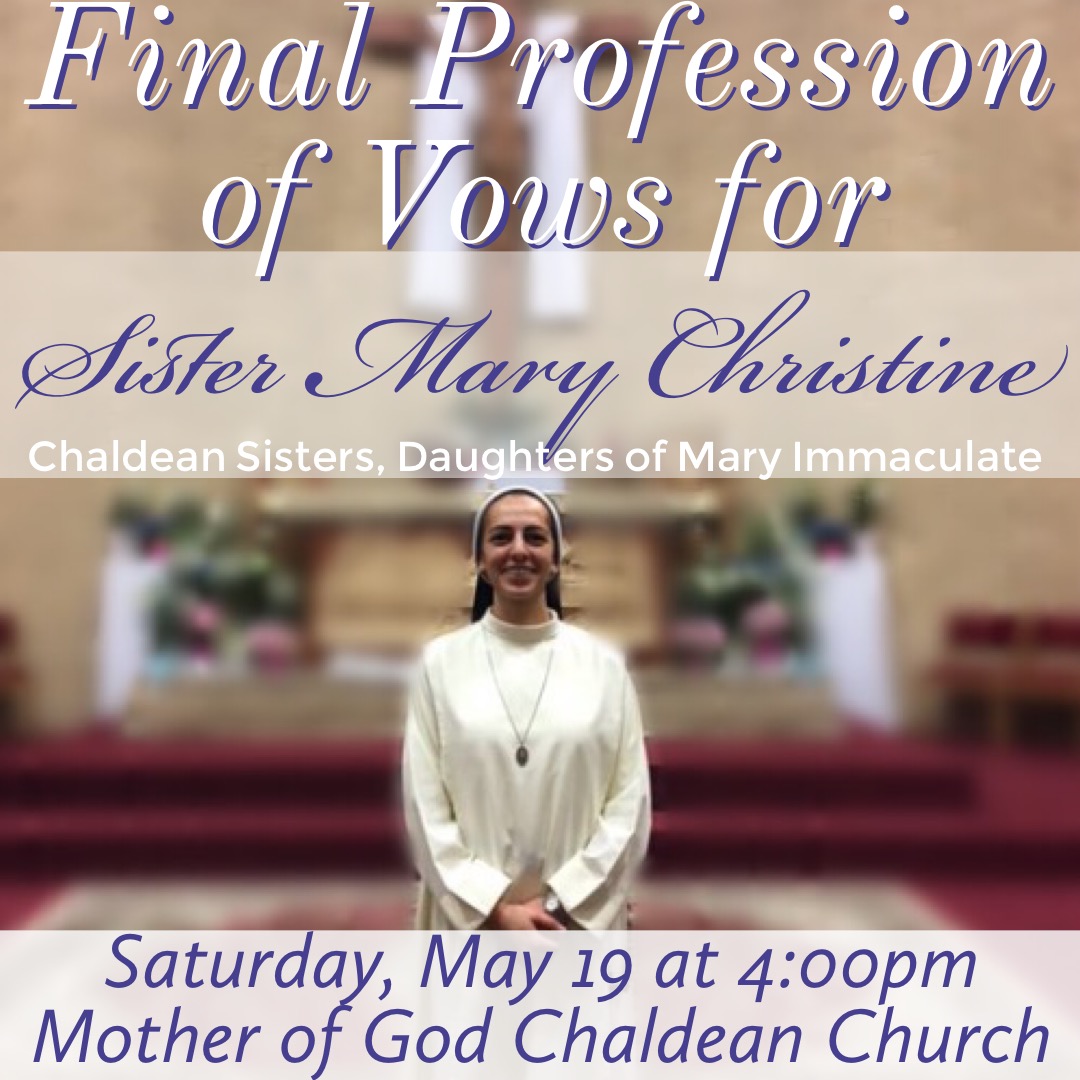
Final Profession of Vows for Sister Mary Christine


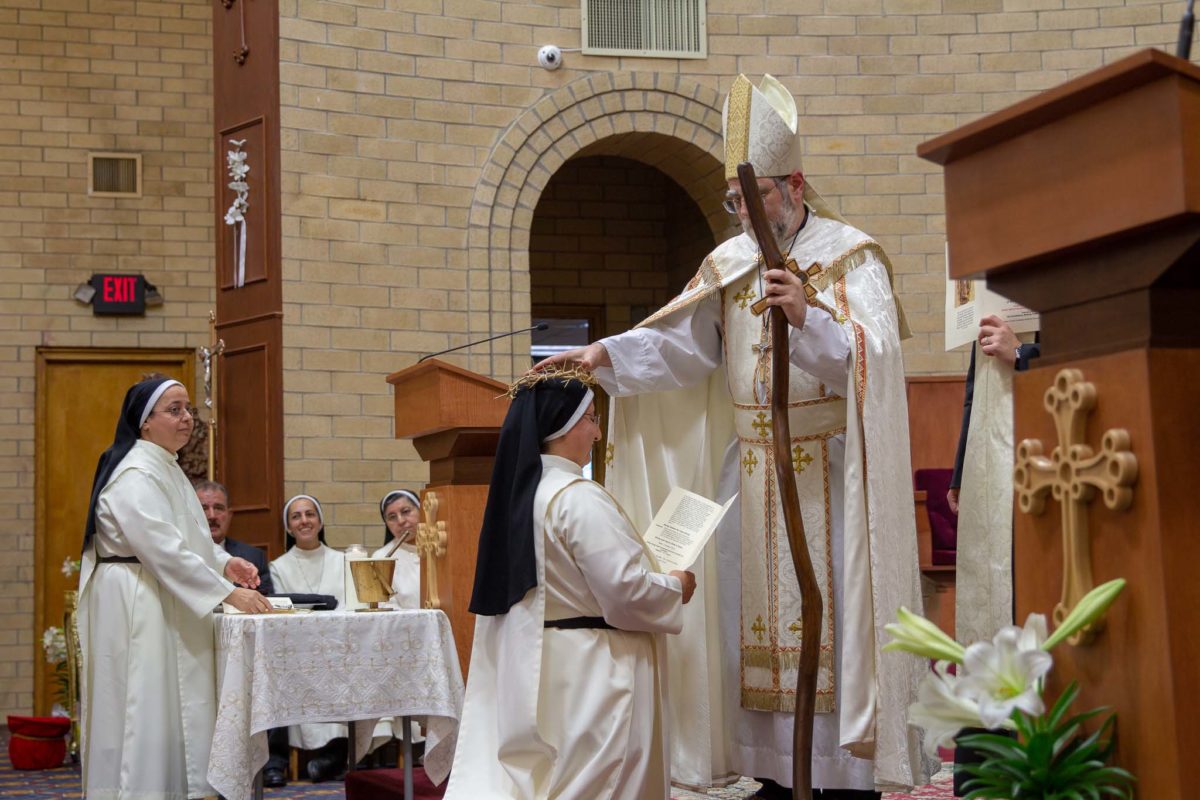
Sister Christine Foumia is the first American born nun to profess her final vows in the Chaldean Sisters, Daughters of May Immaculate.  She will be professing her final vows and becoming a professed nun on May 19, 2018 at 4pm at Mother of God Cathedral.

All are welcome to join the ceremony at Mother of God.  We ask you please keep Sister Christine in your prayers as well as all those discerning the religious life!

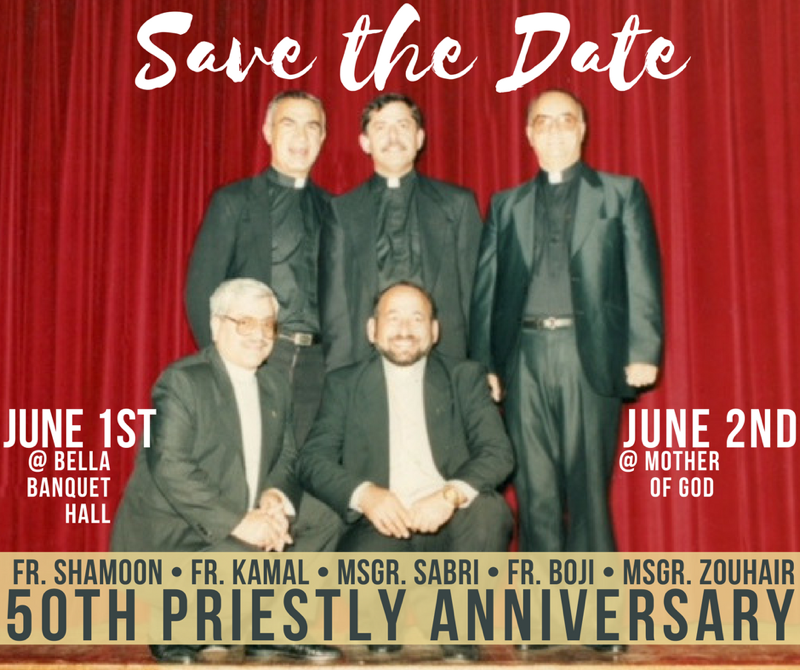
50th Priestly Anniversary

Save the Date
-Form for registration: REQUIRES first name, last name, how many people are attending, and telephone number
-It’s free of charge, light appetizers provided
-Location: Bellagio’s on 14 & Ryan
-Doors open at 7pm Program starts 8pm

– Registration is ONLY required for June 1st at Bella
-Click HERE to RSVP

Updated Clergy Assignments

Dear Faithful of the Chaldean Catholic Eparchy of St. Thomas the Apostle,
The clergy assignments have been updated this year and include the following:

– Fr. (elect) John Jaddou, expected to be ordained on June 30, 2018, will be assigned as
Parochial vicar of Saint Joseph Chaldean Catholic Church in Troy, Michigan.


-Fr. (elect) Fadie Gorgies, expected to be ordained on June 30, 2018, will be assigned as
Parochial Vicar at Our Lady of Perpetual Help Chaldean Catholic Church in Warren,
Michigan. Fr. (elect) Gorgies will also be assigned to the Chaldean Church’s mission to
the Chaldean community in Boston, Massachusetts, visiting at least once a month to
celebrate Mass.

– Fr. Pierre Konja will be assigned as a spiritual director at St. Peter Chaldean Catholic
Seminary in Ankawa, Iraq. The role of a spiritual director is to help one to recognize how
God is working in their lives and to help one grow in holiness.

– Fr. Bryan Kassa will be assigned as the vocations director of the Eparchy, an assignment
formerly held by Fr. Pierre Konja. The role of the vocations director is to help men and
women who are exploring a possible vocation to either the priesthood or religious life to
discern properly and effectively. The vocations director also has a role in helping to form
the men who are currently in the seminary program. Fr. Kassa is expected to start this
assignment officially on May 1 st due to Fr. Konja’s new assignment in Iraq.

– Fr. Sanharib Youkhanna will be assigned as the Rector of Mother of God Chaldean
Catholic Cathedral in Southfield, Michigan.

– Fr. Hermiz Haddad will be assigned as the Administrator of Mar Aprem Chaldean
Catholic Church in Chicago, Illinois.
All assignments, with the exception of the Vocations Director, will officially begin on August 1 st .
Please continue to keep the Eparchy and your brother clergy in your prayers.

Urgent Cancer Relief Fund (UCRF)

“Live simply so that others may simply live.” -Mother Teresa
As we begin our Lenten journey towards Easter, let us remember that Lent is not only a time to turn away from sin, but also a time to help us return to the simple things: prayer, fasting, and almsgiving.
This Lent, as an act of almsgiving, consider donating Help Iraq’s Urgent Cancer Relief Fund to help give our brothers and sisters in Christ a fighting chance against cancer. These cases are especially urgent, and their families are desperate to help their loved ones.
To donate, please Click Here. 100% of your donation goes directly to those in need.

Fr. Pierre Konja’s Assignment

It’s with a bittersweet heart that I write this article to my beloved home parish and the people God has trusted me to serve.
At the end of April I will be leaving Mother of God church and I will begin a year long assignment in Iraq.
Let that soak in.
Now, let me explain. When I first joined Seminary I knew that I would have to learn Chaldean, and maybe even Arabic, in order to serve the Chaldean Church. I even discerned becoming a Roman Catholic priest because the daunting task of learning these languages gave me such deep anxiety. God, however, made it clear to me that he called me to be a Chaldean Catholic and he was calling me to be a Chaldean Catholic priest.
Throughout my six years of Seminary and my almost seven years of priesthood I’ve worked at my Chaldean studies. I can celebrate mass and carry a very simple and broken conversation, but my time doesn’t allow me to really become fluent in the language. Being in Iraq, immersed in the language and culture will (hopefully) change that.
Also, I don’t know any Arabic and my lack of languages has hindered my ability to serve the many people of God whose preferred language is Arabic.
So, for the past few years I’ve been asking the bishop to send me to Iraq where I can study Chaldean and Arabic in a more immersed way, enrich myself with the culture of my forefathers, assist where I can in teaching English, build bridges with the Church in Iraq and the Church in Detroit, and be open to the graces the God has in store. With approval of Bishop Francis and Patriarch Sako, I’ll depart in early May and return in June of 2019.
This is my choice and I make it freely and with a very peaceful heart.
In the past couple years many places in Iraq have become more stable and I have great confidence in my safety because I’ll be going with an official assignment letter and be welcomed by the bishops with official letters.
My replacement will be announced in March and will begin in August.
I have great faith in this parish. It’s my home, it’s where I received the sacraments, where I fell in love with Jesus, and where I discerned my call to serve his Church. Now it’s time for me to better myself, serve elsewhere, and entrust my home to another priest.
Please keep me in your prayers. You will perpetually be in mine.
Everything for the greater glory of God.

An interview with Fr. Patrick Setto

Fr. Patrick Setto is the newest ordained priest of the Chaldean Catholic Eparchy of St. Thomas the Apostle, ordained July 2nd of 2017. Fr. Setto answered these questions when he was still a deacon preparing for his ordination.


Q: Tell me a little bit about yourself. (Home parish, family background, etc.)


I am the son of Moayad and Laman Setto, and I am the youngest and only boy with three older sisters: Lisa, Sandra, and Terry. I grew up serving as an altar boy at St. Joseph’s Church, and I have always loved to be around family and friends.


Q: Tell me a little bit about your faith background.


Ever since I could remember, I have been naturally drawn to Jesus, Mary, and the saints. As a young boy, my favorite movie that I watched all day long was the 6.5-hour movie, “Jesus of Nazareth.” I would watch this day and night while dressing up like Christ and reenacting the characters as I watched. I would also would play “Mass” with pita bread and collect religious statues and images. All of this was natural for me without anyone telling me to do it. Because of this, my parents would bring me to mass, and I would serve as an altar boy. My grandmother also had a huge influence on my faith. When she would babysit me, she would sit me on her lap, and I would hold one half of the rosary and she the other and we would pray together.


Q: What led you to the priesthood?


Priesthood was always something I thought about. Growing up, I retained a strong love for God; however, it wasn’t until I was 18 when I went on Kairos and had a personal encounter with Jesus. It was after that retreat that my life completely changed, and my love for Jesus went from simply images to a real person. This change came about in me when I finally came to learn the truth about Jesus in the sacraments—especially in the Eucharist—and God’s endless mercy through the sacrament of reconciliation. As I received God’s love and mercy in such an effective way through these great sacraments, I desired nothing else than to share them with everyone I came in contact with. I participated in leading other retreats and teaching in youth groups such as JCU, where I found so much joy and satisfaction. I was later introduced to The Diary of St. Faustina where I learned about Jesus’ endless mercy (which I found myself so much in need of). As I learned about Jesus’s thirst to save souls and to pour out His mercy on sinners, I began to taste a little of this thirst to save souls. It was then that I realized that my vocation was to share this love and mercy in the most direct way with the whole world, and that is primarily through the priesthood.


Q: Why become a priest?


Simply because of the Eucharist. Christ gave up Himself on the cross for our salvation, and it is that same Christ who continues to offer up Himself by coming to us in the form of ordinary bread. If this is true, it is worth giving up everything else just to make Jesus present through the sacraments, especially In the Eucharist.


St John Paul II once said that “one finds his true self in giving of himself.” There is nothing more fulfilling than to be able to give myself to Christ through giving my whole self to the others.


Q: Any special memories of past pastors/priests?


I will never forget the time back in 2009 when I was still discerning whether God was calling me to seminary. I was waiting in line for confession at St Cyril’s, and I was praying the first joyful mystery, “The Annunciation,” and I was asking Our Lady to help me say yes to God if he is calling me the way she said “yes” to God at the Annunciation. I asked her to give me a sign if God was calling me and if she was to lend me her “yes” to God. After entering the confessional and confessed my sins, the priest, who was Fr. Valerian Rykowski—an extremely holy and gifted priest—asked me to come from behind the screen and sit in front of him. After asking me a few questions, he looked at me strongly and said, “You will be a priest.” There were other encounters where Fr. Val had told me that God was calling me, but this time, he prophesied that I would become a priest.


Another priest who has had a huge influence on my vocation is Fr. Ben Ludtke. From my very first confession with him until now, he has been nothing short of an amazing example of what a true priest must be like. My first confession with him was so special because he was able to show me God’s mercy and compassion in a way that I never had felt before. His love and devotion to hear confessions day in and day out for hours at a time really showed me just how merciful God truly is. I pray to have this same passion for the sacrament of reconciliation in order to show the world God’s endless mercy.


Q: How has your time in seminary help prepare you for your upcoming ordination?


Seminary was truly the greatest gift I have received in my life thus far. I would never be the man that I am today if it weren’t for seminary. Seminary life taught me to grow in many incredible human qualities such as discipline, patience, productiveness, sensitivity to others, and most of all, it taught me how to love Christ above all. Through our daily schedule of morning prayer and mass, to classes and ending the evening in prayer, we were truly able to grow in our love for Christ on a spiritual level and to grow as stronger men on a human level. Seminary focuses on forming us into priests on four different levels or pillars: the spiritual, human, intellectual and pastoral pillars. The program was set up for us to be able to work and grow in these four areas of our lives so that we could become more whole and healthier in mind, body, and soul. The more we are able to become whole, the more effective we are in helping others.


Q: What are you looking forward to most as a priest? What are you least excited about?


I am most excited about celebrating mass and hearing confessions. My whole motivation to become a priest was to make Jesus present in the Eucharist and to communicate his mercy through the sacrament of reconciliation. I am excited about just being able to be an instrument of Christ in whatever way that I can to help souls experience the concrete love of Christ so that they can be with him for all eternity. I am sure there will be things that don’t excite me as much about priesthood, but at this time I am so excited just to be a priest that I am not aware of anything that would make me unexcited.


Q: Is there anything that you find special about about our Eparchy that you would like to share?


I think what is so special about our Eparchy is that we are so closely connected by our culture. I also really love the fact that the youth play such a huge role in our Church. When looking at the Catholic Church at large, you don’t usually see the youth or young adults as involved in Church as you can see in our Church.


Q: How are you feeling about your first assignment at Mother of God in July?


I am really excited to be at our Cathedral because it is the mother parish of all the parishes in the diocese. I love that Mother of God is always offering all kinds of programs and activities that can involve the whole diocese. It is really the home Church that is able to bring all of the other smaller communities together to really feel like one family, and I really look forward to being able to serve not only our parishioners, but our diocese at large.

An interview with Fr. Bryan Kassa

Fr. Bryan Kassa celebrated his first year as a priest on July 2nd, 2017. He is currently an associate pastor at St. Joseph Chaldean Catholic Church in Troy, Michigan. 


Q: Tell us a little bit about your call to the priesthood. 


I don’t think I was taking my faith seriously until I was dating a girl who really challenged me to confess my sins. I thought, “I don’t need to do that, I’ll just confess directly to God.” 


She said, “Do you believe that the Holy Spirit has been guiding the Catholic Church for the past two thousand years?” I said, “Of course, I do.”


“Do you think you’re smarter than the Holy Spirit?”


I thought, “Wow, she’s right. Who am I to say I don’t want to confess my sins to a priest?” I started to understand what the Church teaches is true and I fell in love with the Church. That was the beginning of my vocation. 


I see now how God was working in that situation. The Church was able to answer all my questions rationally and logically, and I just started to love the Church even more.


Q: What about the priesthood do you enjoy most?


When I was in high school, I wanted to be a pediatrician. But the “Chaldean” in me didn’t want to wait eight years to finish college and so I changed my major to accounting. With that being said, I always wanted to be a doctor even as a young child because I wanted to bring healing into the lives of others. At the time, I didn’t understand how that desire would come to fulfillment, but now I do. As a priest, I am able to bring healing into the lives of others but it is a different kind of healing—it is spiritual healing. Like the body, the soul is a living component and needs healing. The same way God uses a doctor to heal the bod, he uses a priest to heal the soul. The soul can get sick from sin and/or previous traumatic experiences, and God in His wisdom uses a priest to heal His people through the Holy Bible, the Sacraments, and other forms of healing prayers. That is one of the things that I enjoy most about being a priest.  


Q: What is it about the priesthood that you enjoy least?


The Chaldean language is a struggle for me in my priesthood.  I love being Chaldean and I love our traditions and customs but the Chaldean language doesn’t love me back sometimes (that is supposed to be funny in case you didn’t laugh). As a priest, I have to use the Chaldean language to read the Holy Bible, funeral prayers and other Sacramental readings. Besides reading it, I have to speak Chaldean to my parishioners—not only in my homilies but also in one-on-one conversations, and it leaves me tongue tied at times; however, my parishioners are very encouraging and motivate me each day telling me that I am growing in my reading and speech. My response to them at times is, “If I am improving, why do I see you laughing at me at times?” which makes them laugh more, and I laugh too. It is important to be able to laugh at yourself. I like the quote, “Take your work seriously, but yourself lightly.”


Q: What have you enjoyed most about being at St. Joseph?


I love the faith of the people here. The majority of them know what a privilege it is to worship their Christian faith freely and they don’t take that for granted. That is something that many of us Chaldean Americans will never experience or understand. They worship with their whole heart! It is truly inspiring. Best of all, they tell me that they pray for me, so I know God hears the prayers of this faithful community!


Q: What does a typical day for you like?


I like to wake up at 7:30 am usually. I like to go for a run in the morning to help give my body the natural chemicals that it needs to help me stay focused.  Running helps me channel any anxiety, fear, or worry that may try to creep its way into my life. After taking care of the body that God gave me, I take care of my soul by praying a Holy Hour in the adoration chapel. During my Holy Hour, I read the Holy Bible, which is God’s Word today for me! Even though He was speaking to His prophets thousands of years ago, the Holy Bible makes God’s Word alive today! I need to hear His voice. I need Him to guide me in my upcoming appointments. I need to fill myself up with Jesus before I even dare speak to people about spiritual matters. Next, I celebrate Mass then the meetings begin for the day. Those meetings can range from a married couple struggling in their marriage to someone who wants to learn how to grow in their personal relationship with Jesus. In between what I mentioned, I have to return phone calls, e-mails, text messages, visit people in the hospital, take care of people who want to speak to a priest without an appointment, and any other fun adventure which presents itself in between. It seems like a lot—and it is—but I love it.  It is pretty incredible what God can do through a single person in one day.   


Q: What can you tell us about Liquor Store Evangelization? How did it start?


Funny question! My parents are hard workers, and I always wanted to help them as much as possible at their store when I had free time. I did not enjoy being at the store, but it gave my parents some time off which made me happy. With time, I realized how miserable I was becoming at the store. I would get annoyed when I would see or hear a customer coming into the store. I couldn’t wait for them to leave at times and then one day it hit me—“What if that customer is Jesus?” So, I prayed this prayer, and my miserable life at the store began to change:


“Jesus, I don’t see You in these customers. I have a hard time loving them, but You love them. I am not sure what You love about them but You do. Since You love them and I am struggling to love them and to see You in them, I give You permission to love them through me! Help me to get out of the way!”  


After that, I slowly started to feel the prompting of the Holy Spirit direct me to engage in conversations with the customers rather than rushing them out of the door. I wouldn’t wish people “good luck” after they played lottery, I would wish them “many blessings.” I wouldn’t wish them a “good day/night,” I would wish them a blessed day/night. When people asked me how I was doing, I would respond, “I woke up today, so for that reason alone, I am doing amazing.”  


I talked my parents into getting rid of the pornography and condoms which were sold at the store which were against what we believed in as Catholics and when a customer would ask why we don’t sell condoms and pornography, I would bring up God’s law rather than man’s law—it was an opportunity to teach others what I believe in rather than hide what I believe in. If the “truth” that Jesus talks about will set people free, then I wanted my customers to be free from their addictions of alcohol, cigarettes, lottery, etc.


Our store is near a hospital, so when I would see a white hospital bracelet around their wrist, I would ask if they were okay and engage in conversation with them, reminding them that Jesus is the Divine Physician and that He loves them.  Often times, I would offer to pray with them and on them right then and there.


Q: Tell us a bit about your spirituality. What is the most spiritually rewarding part of being a priest?


I like the spirituality of St. Therese of Lisieux. She speaks a lot about the “Little Way” to get to Heaven…how “little” souls—because they are weak, broken, and not perfect—need a shorter and easier way to get to Heaven because of their limitations and weaknesses. She really taught me a lot about God’s love and mercy because I often saw Him as a mean judge only. My spirituality is a combination of God’s love and mercy, but also as a Father who wants the best for His children and who continues to challenge His children so they can get to Heaven. As a priest, I love to be able to do the same with my parishioners…teach them about God’s love and mercy but also challenge them to be better Christians and to follow Christ without reserve.  


Q: What has been the hardest thing about being a priest?


The hardest thing as a priest is finding a balance between being a happy, holy, and healthy priest. I believe that a lot of it has to do with the evil one.  


I think that since a priest wants to save souls and the devil wants to ruin souls, it is hard to not fall for the devil’s tricks and lies. He tries His hardest to tell me that a particular person has no hope and that it is pointless for me to pray for that individual. Or the evil one tries to lie to me and trick me into thinking that I am not a good priest and have nothing to offer. He tries to make me believe that I am superman and that I don’t need a lot of sleep in hopes of me burning out. He tries to make me believe that I am super holy and don’t need to pray at times. He tries to trick me into thinking that I am the Savior of the world when in actuality, the world has a Savior already. His name is Jesus, in case you were wondering.


That is why it is important to stay close to Christ. To build that ongoing relationship with Him, not only as a priest, but also in general as a Christians living in this secular world.  


Q: Where do you see yourself in the next 5 years?


In the next 5 years, I see myself still struggling with my Chaldean but loving every second of being a priest!